
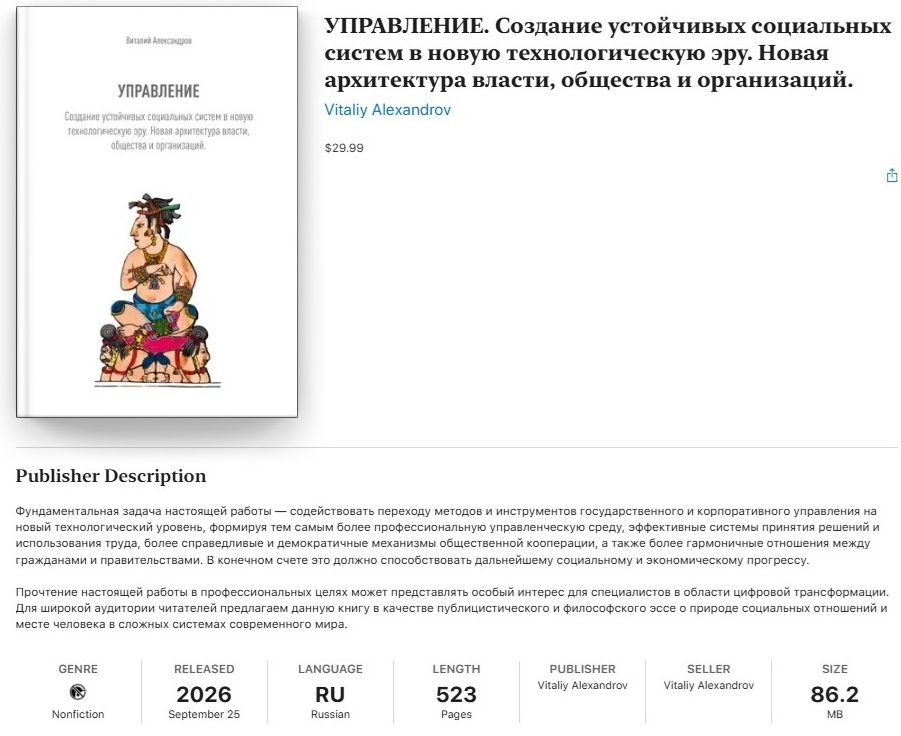
Copyright © 2026 Vitaliy Alexandrov
All rights reserved.
First edition. 523 pages, illustrated. In Russian.
The central aim of this book is to advance the methods and tools of public and corporate governance for a new technological era. It seeks to encourage more professional management, more effective decision-making and use of human resources, fairer and more democratic forms of social cooperation, and more harmonious relations between citizens and governments. Together, these changes can contribute to further social and economic progress.
This book may be of particular interest to professionals working in digital transformation. For general readers, it offers a philosophical essay on the nature of social relationships and the place of the individual in the complex systems of the modern world.
This work may be used freely for academic purposes worldwide in support of these aims.
The use of images, graphics, and text from third-party sources cited or reproduced in this book is subject to applicable copyright law, licence terms, and any conditions set by the rights holders. Permission from the relevant rights holders is required before these materials are reproduced, distributed, adapted, or otherwise used, unless such use is permitted by law or an open licence.
This scholarly publication includes quotations and illustrative material from other works to the extent justified by its research and educational purposes. Sources and authors are acknowledged, and such use is intended to comply with applicable copyright law and the principles set out in Articles 9(2) and 10(1)–(3) of the Berne Convention for the Protection of Literary and Artistic Works (Paris Act of 24 July 1971, as amended on 28 September 1979).
ISBN 978-601-12-9564-2 (e-book edition)
Subjects: Public and corporate governance; decision-making systems; social network analysis; social capital; network governance; systems theory; organizational theory; sociology; behavioral economics; cybernetics; digital transformation; e-government; big data; spatial data visualization; forecasting; institutional reform; mass communication; economic governance; international relations.
This book is an independent work of research. Its conclusions, assessments, interpretations, and scholarly arguments reflect the author’s views and do not necessarily represent those of any government body, international organization, institution, or academic institution.
Digital tools, including artificial intelligence, were used to assist with research, translation, editing, information analysis, and the creation of some illustrations. The author takes full responsibility for the book’s content, scholarly integrity, factual accuracy, conclusions, and views.
The author is grateful to the scholars, researchers, public officials, engineers, designers, analysts, and practitioners whose work and ideas, cited in the bibliography, contributed directly or indirectly to the preparation of this book.
Almaty • Astana • Almaty • Singapore • Astana • Bangkok
2009–2026